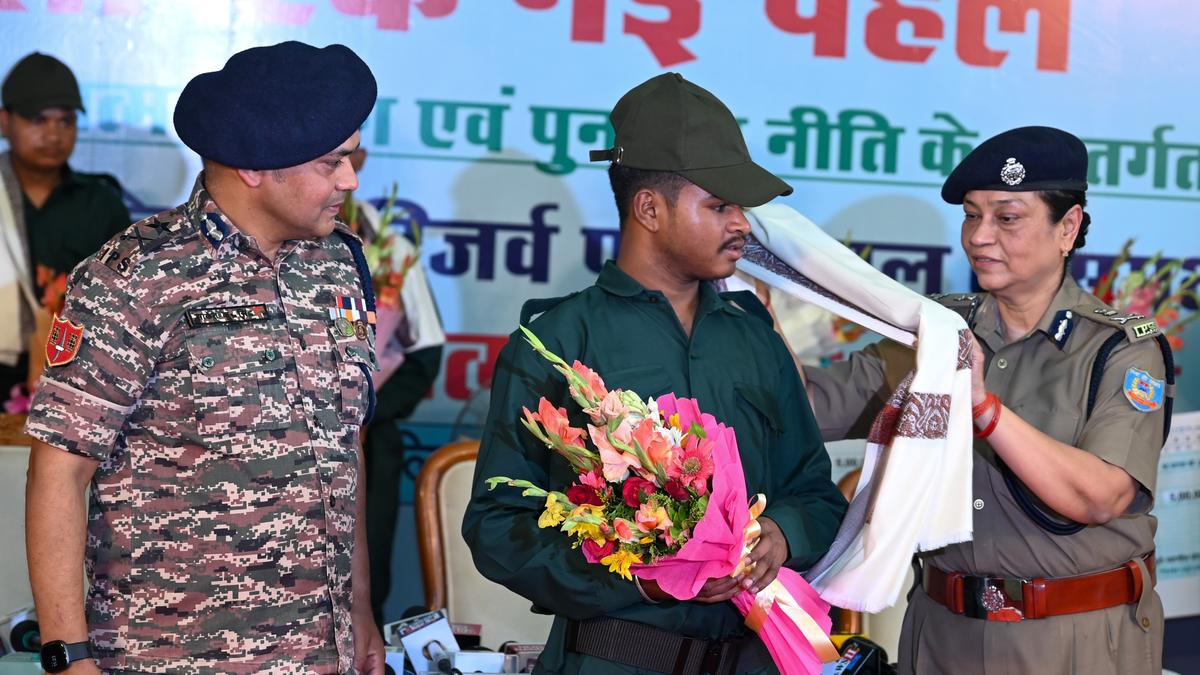
A group of 27 Maoists surrendered before the Jharkhand police on Thursday (May 21, 2026), as part of Operation Navjeevan. The group includes commanders and strike squads of the banned Communist Party of India (Maoist), active in the Kolhan and Saranda regions, as well as two leaders of the Jharkhand Jan Mukti Parishad (JJMP) active in Gumla district.
The Jharkhand police, along with its anti-Naxal unit Jharkhand Jaguar and the COBRA unit of the Central Reserve Police Force, is conducting operations against the Maoists, under the Jharkhand government’s surrender and rehabilitation Policy.
The Maoists surrendered their arms before the Jharkhand Director General of Police Tadasha Mishra and other senior police officials in an event at Ranchi.
Commanders and strike squads
Those who surrendered included JJMP sub-zonal commanders Sagen Aangariya alias Dokol, wanted in 123 cases, and Sachin Beg, wanted in six cases and carrying a reward of ₹5 lakh. Last year on May 24, JJMP supremo Pappu Lohra alias Suryadev Lohra was killed on May 24 last year, during an exchange of fire with security forces in the Ichabar forest of Latehar district.
The 25 Maoists comprised six sub-zonal committee members, six area committee members (ACMs) and 13 squad members. They included the cadre associated with the team of CPI (Maoist) Central Committee member Misir Besra (alias Sagar Ji), top commander Asim Mandal, and members of strike squads — individuals who possess detailed information of the remote forest of Kolhan and Saranda. Mr. Besra is the last active Politburo member of the banned outfit, carrying a bounty of ₹1 crore on his head.

Arms and ammunition surrendered by 27 Maoists are displayed during an event after their surrender, in Ranchi, Jharkhand on May 21, 2026.
| Photo Credit:
PTI
“The Jharkhand police is continuously striving to bring misguided Maoists back into the mainstream. These efforts have yielded highly positive results. To date, numerous Maoists, ranging from high-ranking commanders with bounties on their heads to squad members belonging to the CPI (Maoist) and other banned Maoist organisations, have surrendered before the Jharkhand police,” a senior Jharkhand police officer said.
Rejoining the mainstream
The officer added that, driven by internal exploitation and intimidation within the CPI (Maoist) organisation, as well as the police’s relentless and mounting pressure, many Maoists are choosing to rejoin the mainstream.
As per data available with the Jharkhand police, 44 Naxalites have been arrested so far in 2026, while 29 have surrendered before the police, and 22 have been killed in police operations.
The Jharkhand police has appealed to the remaining Maoists to abandon the path of violence and extortion, return to the mainstream, and avail themselves of the benefits offered under the Jharkhand government’s surrender and rehabilitation policy.’
Weapons surrendered
The Maoists who surrendered on Thursday also laid down 16 weapons and 2,857 rounds of ammunition. These CPI (Maoist) members were residents of West Singhbhum (Chaibasa) and Giridih districts.
“Their surrender is expected to curb Maoist activities within Jharkhand — particularly in West Singhbhum (Chaibasa) and the surrounding districts — as well as across the State at large. The surrender of this entire group constitutes a severe blow to the local CPI (Maoist) squads,” said the officer.
To curb Maoist activities within the Chaibasa district — and to sustain the sense of security among the general public in Naxal-affected police station areas — a total of 21 new security camps, comprising advance camp locations and forward operating bases, have been opened in the Saranda region.