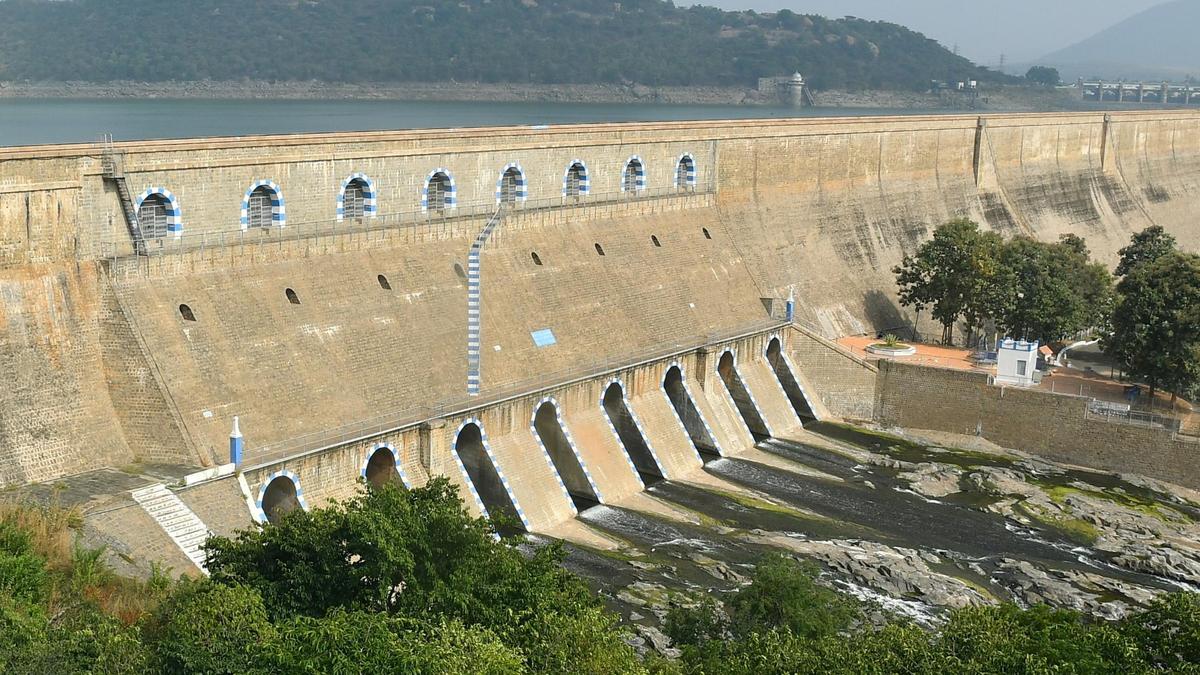
The probability of the Mettur dam getting opened on the scheduled date of June 12 appears to be remote, in view of the poor storage and the forecast of a poor southwest monsoon (June-September) this year.
Giving an account of the situation on the water front, a senior government official said the storage of the dam was “not even 50%.” The India Meteorological Department had predicted the delayed onset of the monsoon, apart from lowering its forecast to 90% of the long period average of rainfall against the original 92%. Under such circumstances, it is “out of the question” to open the dam, observes the official. As on Saturday(May 30), the dam’s storage was about 41 thousand million cubic feet (tmcft) against the capacity of 93.47 tmcft. Inflow to the dam was around 1,950 cubic feet per second (cusecs), with the outflow being about 1,000 cusecs.
Besides, the storage of reservoirs in the Karnataka portion of the Cauvery river basin is not encouraging. According to the Karnataka State Natural Disaster Monitoring Centre’s report for the day, the combined storage of the Krishnaraja Sagar and Kabini dams, from which water is released to Tamil Nadu through the river, is 16.09 tmcft against the total gross capacity of 68.97 tmcft. There are two other dams — Harangi and Hemavathy — which are upstream of the first two. Their storage is 17.75 tmcft, while the capacity is 45.6 tmcft. According to the data available with the Central Water Commission, Tamil Nadu realised, as on May 26, about 330 tmcft at Biligundulu against its share of 176.85 tmcft during the water year 2025-26 (June-May).
During the previous DMK regime (2021-26), barring 2024, the Mettur dam was opened on the scheduled date in three years and ahead by a few weeks in 2022. Two years ago, the water release for irrigation commenced on July 29, when the storage was approximately 88 tmcft. On 20 occasions in the 92-year-long history of the dam, the water release began on the customary date, including last year.
Given the current storage at Mettur, the coverage during the kuruvai cultivation season would, at best, be 2.5 lakh acres, in view of around 1 lakh filter points or borewells. In recent years, the normal coverage during the kuruvai season in the delta has been around 4.4 lakh acres. Last year, it touched an all-time high of about 6.09 lakh acres. If farmers go for the earlier normal coverage of 3 lakh acres, they would require at least 80 tmcft. The government is considering an assistance package for the farmers to raise paddy during the season, the official points out, adding that it is also receptive to the idea of encouraging farmers to grow pulses more.
An agricultural expert says it would be advisable for farmers to complete the sowing for pulses — ordinarily in Tamil Nadu, black gram — by the second week of June or as early as possible. The crop’s duration is, on an average, 60 to 70 days. If farmers delay raising the crop, they may have to face the risk of crop damage in the later part of the southwest monsoon or the early part of northeast monsoon (October-December).