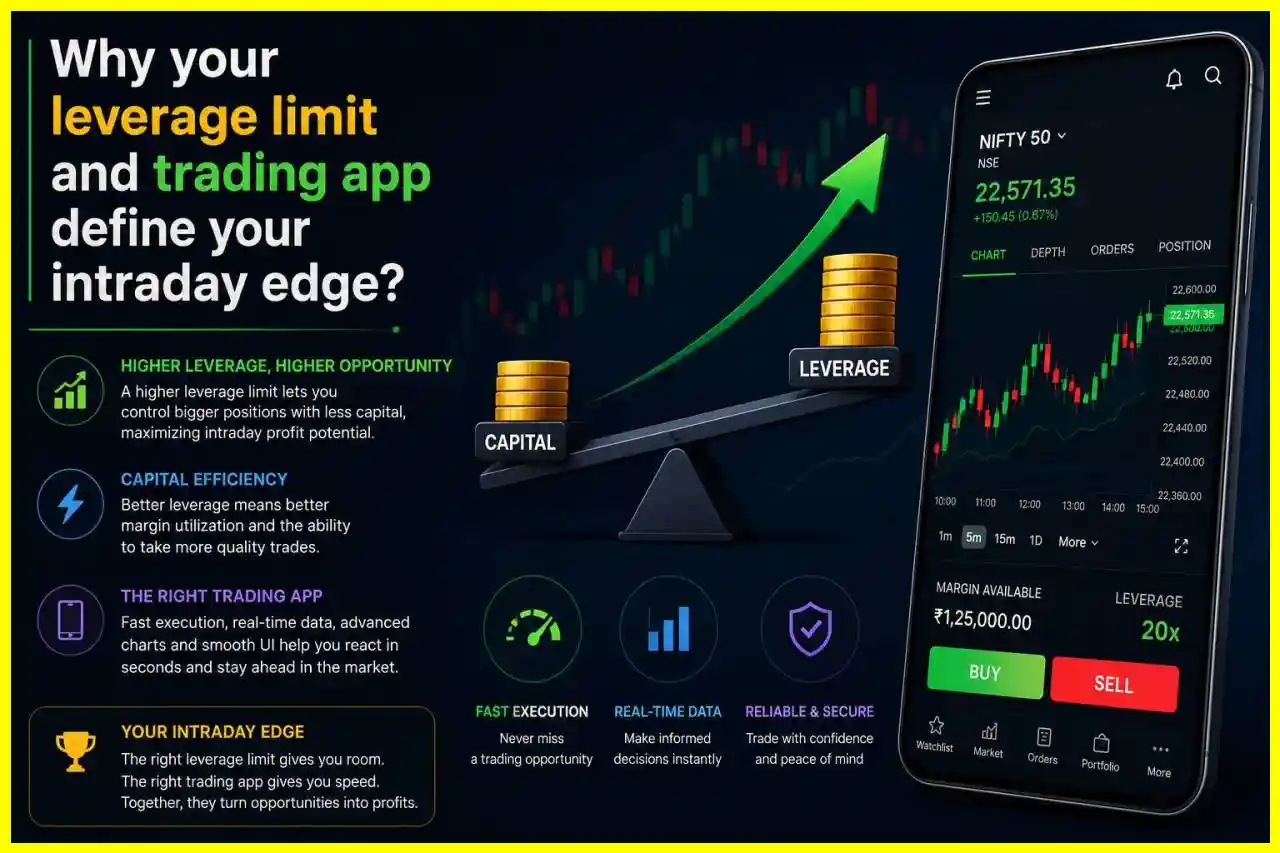
Many intraday traders spend most of their time refining strategies, entries, indicators, and chart patterns to gain an edge. But two factors that usually get overlooked can have just as much impact on performance: your leverage limit and the trading app you use.
The effectiveness of execution, risk management and response time is directly impacted by these factors. In today’s fast-paced intraday trading, where timing and precision matter, even small differences in execution or position sizing can make a large impact on your returns.
Because of this, traders need to understand how leverage and platform choice shape their trading experience, which can help them build a more practical and consistent intraday approach.
Understanding leverage in simple terms
With the help of leverage, you can enter a bigger position than you can afford. For example, if your broker offers 5x leverage, you can trade ₹5,00,000 worth of stock with ₹1,00,000 of your own money.
This increases both potential returns and potential losses. A small price movement can lead to a meaningful profit—or a quick drawdown.
For intraday traders, leverage is attractive because it makes short-term opportunities more impactful. But the key point is this: leverage does not create an edge by itself. It amplifies whatever edge—or mistake—you already have.
How the leverage limit affects your trading decisions
Different traders use different leverage limits. Regulations, broker policies, and your assets can determine the limit of your trading position.
A higher leverage limit gives you flexibility. You can scale positions, diversify across trades, or allocate capital more efficiently. However, it also requires discipline. Without proper risk control, higher leverage can lead to overtrading or oversized positions. Traders should be aware that the highest MTF limit in India is regulated by SEBI.
If the broker is offering you lower leverage, it makes your trades selective. It will limit the number of trades. For example, two traders might see the same breakout opportunity. One of them uses high leverage, hence takes a large position. The other uses moderate leverage and sizes the trade conservatively. The outcome may depend on how each trader manages exposure.
The role of your trading app in execution
Intraday trading usually involves reacting to fast price movements. Delays or technical glitches can impact your entries and exits. The best intraday trading app has the following characteristics:
- Faster order execution
- Real-time price updates
- Stable performance during market volatility
- Easy order modification
- Clear and intuitive interface
Execution speed and decision-making
In intraday trading, execution speed affects decision-making. If your app answers quickly, you can carry out your plan without second thought. If it is lagging, you may second-guess entries, hesitate or chase the price after the move is already in motion.
For example, let’s say you want to wait for a stock to break resistance. The breakout occurs, but your app fails to place the order. If the trade gets executed late, the price might get too forward. This will change your risk-reward ratio. Hence, the platform efficiency directly impacts trading outcomes.
Combining leverage and platform efficiency
You need to understand how leverage and platform performance work together.
See the scenario below:
A trader identifies a strong intraday setup. With appropriate leverage, they can take a position size that makes the trade meaningful. At the same time, a fast and stable trading app allows them to enter at the right moment and manage risk effectively.
Now compare this with a trader who has high leverage but uses a slow platform or an unreliable platform. Though the same setup can be used if filling issues exist, it will lead to bad entries, slippage, or missed exits.
In other words, leverage defines your capacity, while your trading app defines your execution quality.
Practical approach for traders
For building a more effective intraday setup, you need to take a balanced approach.
Define your risk tolerance, and depending on that, choose the leverage level. With the given leverage, you should be able to maintain consistent position sizing and manage risk.
If you are facing delays or order errors when placing trades, you may need to change your application.
The following mistakes should be avoided when choosing your leverage limit and trading app:
- Traders chase higher leverage without improving trading discipline. This can lead to larger losses.
- Ignoring platform limitations can affect your trades. Many traders blame strategy failure when the actual issue is poor execution.
Conclusion
In intraday trading, only a strategy does not contribute to a successful trade. It depends on how effectively you can execute that strategy under given market conditions.
Your leverage limit decides how much exposure you can take, and your trading app decides how efficiently you can act on opportunities. Both are crucial in shaping your trading experience. Both are important to your trading.
Utilising it responsibly and selecting a platform that guarantees fast, reliable execution creates an environment where your strategy is more likely to work.
Bhupendra Singh Chundawat is a seasoned technology journalist with over 22 years of experience in the media industry. He specializes in covering the global technology landscape, with a deep focus on manufacturing trends and the geopolitical impact on tech companies. Currently serving as the Editor at Udaipur Kiran, his insights are shaped by decades of hands-on reporting and editorial leadership in the fast-evolving world of technology.