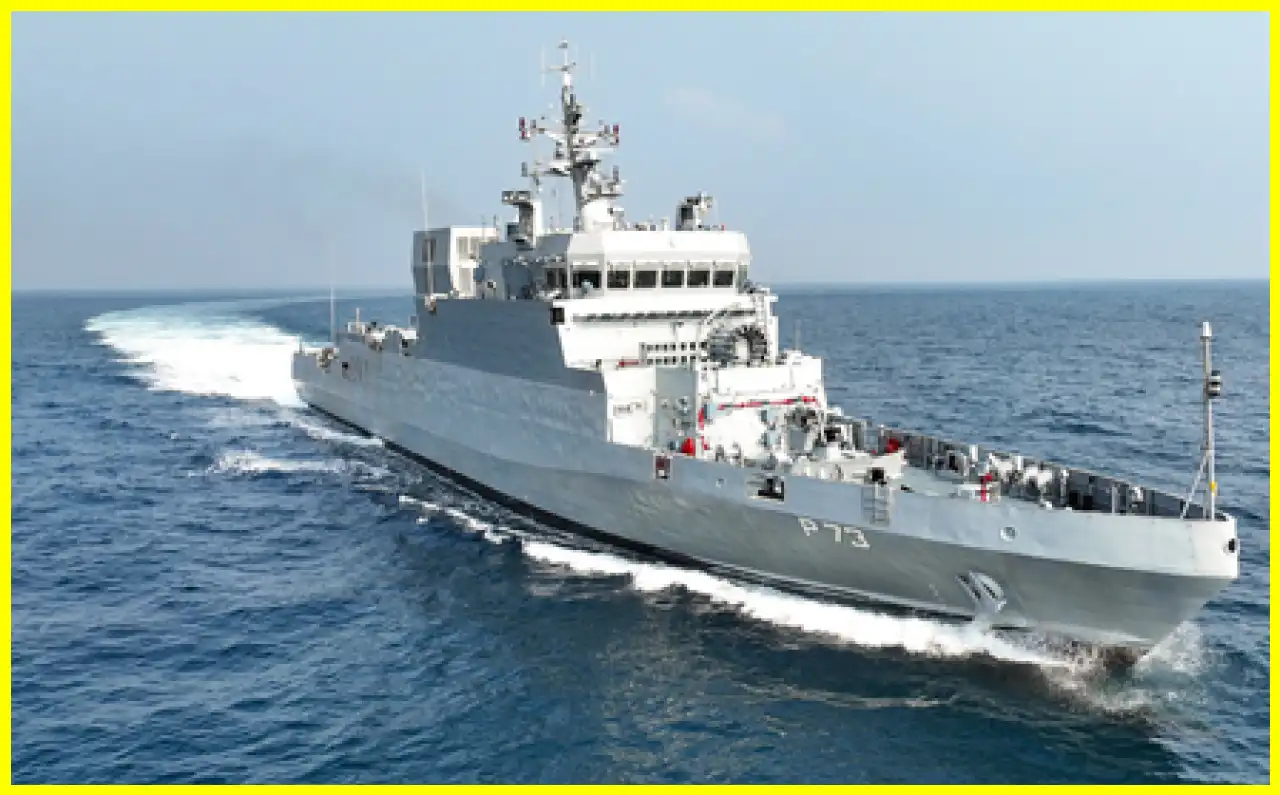
New Delhi, March 31: The Indian Navy is continuously enhancing its strength in the blue waters by incorporating indigenous warships. March 30 marked a historic day as three indigenous vessels were handed over to the Navy on the same day, achieved by Garden Reach Shipbuilders and Engineers (GRSE). The vessels include a guided missile frigate, an anti-submarine warfare craft, and a survey vessel.
The advanced guided stealth frigate ‘Taragiri’ of the Nilgiri class is set to be inducted into the Navy, with a formal commissioning scheduled for April 3 in Visakhapatnam, where Defence Minister Rajnath Singh will dedicate it to the Navy.
Just three days prior, on March 30, GRSE also delivered the fifth guided stealth frigate ‘Dunagiri’ under Project 17A to the Navy. This modern version of the former INS Dunagiri, which was a Leander-class frigate, served in the Navy from May 5, 1977, to October 10, 2010.
This is the fifth warship of the P17A class handed over to the Indian Navy in the last 16 months. The construction time for this vessel was reduced from 93 months to 80 months based on the experiences of the first four ships. A total of seven Nilgiri-class frigates are being built under Project 17A, with the first, INS Nilgiri, inducted in January 2025, followed by INS Himalaya and INS Udaygiri. Now, it is Taragiri’s turn.
All these frigates are equipped with BrahMos missiles, highly effective in anti-ship and anti-surface warfare. Additionally, they feature the long-range Barak-8 surface-to-air missile, air defense guns, indigenous torpedoes ‘Varunastra’, anti-submarine rocket launchers, modern sonar, combat management systems, and multi-function radars, enabling them to detect and neutralize enemy attacks. The frigates also include hangars for two helicopters. Approximately 75% of the equipment is indigenous, and the design is prepared by the Navy’s warship design bureau. Weighing 6,700 tons, these ships can operate at a speed of 30 nautical miles per hour.
To tackle enemy submarines, the Indian Navy has initiated the Anti-Submarine Warfare (ASW) shallow water craft project. In 2019, a contract was awarded for the construction of 16 vessels, with eight being built at Cochin Shipyard and eight at GRSE. Under this project, GRSE has handed over ‘Agre’ to the Navy, following the inclusion of INS Arnala, INS Andrott, INS Mahe, and INS Anjadip. This craft features anti-submarine rocket launchers, lightweight torpedoes, a 30 mm naval gun, hull-mounted sonar, and variable depth sonar. It can operate at a speed of 25 nautical miles per hour and cover a distance of approximately 3,300 km, capable of detecting enemy submarines up to 100–150 nautical miles from the coast.
Understanding underwater conditions and conducting hydrographic surveys is crucial today. These surveys form the basis for preparing charts for safe navigation. The Indian Navy contracted the construction of four large survey vessels on October 30, 2018. In this series, INS Sandhya and INS Nirdeshak are set to be inducted into the Navy in 2024, while INS Ikshak was included last year. Now, the fourth and final survey vessel ‘Sanshodhak’ has also been handed over to the Navy. While the sea surface may appear calm, various threats lurk beneath—some areas are deeper, while others are shallower. Hydrographic maps are essential to avoid these invisible dangers, prepared by such survey vessels. Built by GRSE in Kolkata, over 80% of this vessel’s material is indigenous.
Designed by the Indian Navy’s design bureau, this vessel is 110 meters long and weighs approximately 3,800 tons. Powered by two diesel engines, it can remain at sea for over 25 days and can travel at a maximum speed of 18 nautical miles per hour. This vessel will play a crucial role in India’s maritime security and mapping of maritime areas.
Bhupendra Singh Chundawat is a seasoned technology journalist with over 22 years of experience in the media industry. He specializes in covering the global technology landscape, with a deep focus on manufacturing trends and the geopolitical impact on tech companies. Currently serving as the Editor at Udaipur Kiran, his insights are shaped by decades of hands-on reporting and editorial leadership in the fast-evolving world of technology.