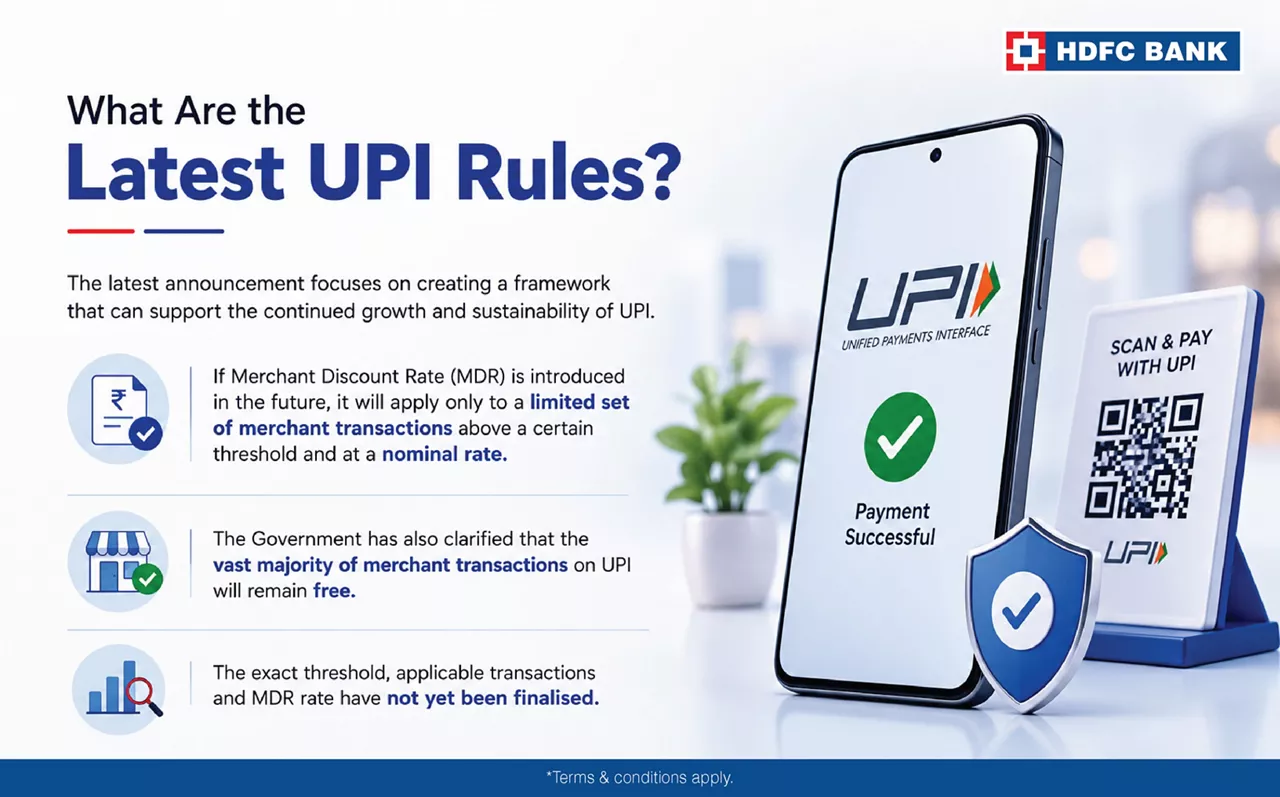
New Delhi, September 16, 2026: India’s Unified Payments Interface (UPI) is set for an important change from October 15, 2026, with the introduction of a new Merchant Discount Rate (MDR) framework for certain merchant transactions.
The announcement has led to confusion on social media, with many users asking whether UPI will now become chargeable for everyone.
The short answer is: No. UPI is not becoming a paid service for ordinary users.
According to the Government of India and the National Payments Corporation of India (NPCI), Person-to-Person (P2P) UPI transactions will continue to remain free regardless of the amount, while payments to merchants up to ₹2,000 will also remain free. The new MDR will apply only to specified Person-to-Merchant (P2M) transactions above ₹2,000.
Here is everything you need to know about the new UPI framework.
What Is Changing in UPI From October 15?
Under the new framework, an MDR of 0.4% will apply to specified UPI Person-to-Merchant transactions above ₹2,000.
MDR stands for Merchant Discount Rate. It is a fee associated with processing a merchant payment through the digital payments ecosystem.
The important distinction is that this is not a charge that UPI users are supposed to pay directly.
The government has specifically clarified that MDR is neither a tax nor a fee collected by the Government or NPCI. Instead, the amount is distributed among participants in the payments ecosystem, including banks and payment application providers.
The new framework will come into effect on October 15, 2026.
Will You Be Charged for Sending Money to Friends or Family?
No.
Person-to-Person transactions will remain completely free.
For example, if you send:
- ₹500 to a friend
- ₹5,000 to your parents
- ₹25,000 to a family member
- ₹1 lakh to another individual
the new MDR framework does not introduce a charge on those P2P transactions.
The government has explicitly stated that there is no impact on Person-to-Person UPI transactions, irrespective of the amount transferred.
In simple terms:
Person → Person = Free
What Happens When You Pay a Shop or Business?
This is where the new framework applies.
A payment from an individual to a merchant is classified as a Person-to-Merchant (P2M) transaction.
For specified P2M transactions:
Up to ₹2,000
No MDR.
Above ₹2,000
0.4% MDR will apply to eligible transactions.
For example:
| UPI Merchant Payment | MDR at 0.4% |
|---|---|
| ₹2,000 | ₹0 |
| ₹3,000 | ₹12 |
| ₹5,000 | ₹20 |
| ₹10,000 | ₹40 |
| ₹50,000 | ₹200 |
| ₹75,000 | ₹300 |
| ₹1,00,000 | Capped at ₹300 |
The ₹300 cap means that once the calculated MDR reaches ₹300, it does not continue increasing with the transaction value. The cap applies to transactions of ₹75,000 and above.
Does the Customer Have to Pay the 0.4%?
The framework says no.
MDR is a merchant-side payment-system fee, not a transaction fee imposed on the customer.
The government has also advised banks to ensure that merchants do not pass the MDR on to customers as a UPI payment charge. UPI application providers are also prohibited from imposing platform fees or hidden charges on users for these transactions.
So if you purchase something for ₹5,000, the UPI payment itself should not suddenly become:
₹5,000 + ₹20 UPI charge
for the customer under this framework.
The ₹20 example represents the 0.4% MDR associated with the eligible merchant transaction, not a ₹20 customer surcharge.
Is MDR a New UPI Tax?
No.
This is one of the most important points to understand.
MDR is not a government tax.
The government has clarified that MDR is not collected by the Government or NPCI as a tax. Instead, it is distributed among participants in the payment ecosystem.
That ecosystem includes institutions such as banks and payment application providers involved in processing UPI transactions.
Therefore, describing the new framework simply as a “UPI tax” can be misleading.
Why Is MDR Being Introduced Now?
For years, UPI has operated at enormous scale while the ecosystem has had to support infrastructure, fraud prevention, cybersecurity, technology development and payment processing without a conventional merchant fee structure for most transactions.
The government’s stated objective behind the revised framework is to create a more sustainable financial model for the UPI ecosystem while keeping everyday payments free for consumers and small merchants.
UPI has grown dramatically in recent years.
According to the government, UPI processed 2,366 crore transactions worth ₹29.9 lakh crore in July 2026 alone. The government also says UPI is now live in 11 foreign countries.
At this scale, the infrastructure supporting instant payments requires continuous investment in areas such as:
- Cybersecurity
- Fraud prevention
- Payment infrastructure
- Technology upgrades
- System resilience
- Customer support
- Innovation
The new MDR framework is intended to help support these requirements.
Will Every Merchant Pay MDR?
No.
This is another major point that has been lost in some discussions around the announcement.
The framework does not impose a blanket MDR on every UPI merchant transaction.
Payments up to ₹2,000 remain free, and certain categories of small merchants continue to receive zero-MDR treatment.
The government estimates that approximately 96% of P2M transactions will remain unaffected by the new framework.
This means the majority of everyday merchant payments will continue without MDR.
What About Small Merchants?
Small merchants have been given specific protection under the framework.
Eligible small merchants operating under the P2PM category and receiving up to ₹1 lakh per month through UPI QR transactions will continue to remain under the zero-MDR framework.
This is particularly relevant for small retailers and low-value merchants who depend heavily on UPI QR payments.
The objective is to prevent the new MDR framework from increasing the cost burden on small merchants and low-value digital transactions.
Are There Special Rules for Railways, Fuel, Insurance and Other Essential Services?
Yes.
The new framework includes a separate structure for certain important industry categories.
For specified transactions above ₹2,000 in categories including:
- Railways
- Telecom
- Insurance
- Fuel
- Agricultural-related payments
- Certain other specified sectors
a flat MDR of ₹5 per transaction applies instead of the standard 0.4% rate.
This distinction is important because these sectors can involve high-value payments but operate with different commercial and public-service considerations.
What About Mutual Funds and Stock Market Payments?
Capital-market-related payments have a separate MDR structure.
Payments involving categories such as:
- Mutual funds
- Securities
- Stockbrokers
- Dealers
will attract an MDR of 0.02%, subject to a maximum of ₹300 per transaction.
The significantly lower rate is intended to avoid creating a large cost barrier for retail participation in formal financial markets.
What About UPI Autopay?
The new MDR framework should not be interpreted as meaning that every recurring UPI payment suddenly becomes chargeable.
Certain recurring and consumer-payment use cases remain outside the standard merchant MDR structure.
For example, reporting on the NPCI framework says that UPI AutoPay for OTT subscriptions continues to remain free.
Users should nevertheless distinguish between the UPI payment mechanism and any separate subscription, platform or service fee charged by the merchant itself.
Will There Be a Monthly Limit on Free UPI Payments?
No new monthly quota has been introduced under this framework.
The government has clarified that consumers will continue to have unlimited free use of UPI, without a monthly number-of-transactions limit created by the MDR framework.
However, banks and NPCI can continue to maintain daily transaction limits for security and risk-management purposes.
Those limits are not the same thing as a fee or a monthly quota for free UPI usage.
What Does 0.4% MDR Actually Mean?
The percentage can sound complicated, but the calculation is straightforward.
Example 1: ₹3,000 payment
₹3,000 × 0.4% = ₹12
Example 2: ₹10,000 payment
₹10,000 × 0.4% = ₹40
Example 3: ₹50,000 payment
₹50,000 × 0.4% = ₹200
Example 4: ₹75,000 payment
₹75,000 × 0.4% = ₹300
Example 5: ₹1 lakh payment
₹1,00,000 × 0.4% = ₹400
But because the maximum MDR is ₹300:
Applicable MDR = ₹300
Again, these calculations describe the merchant-side MDR under the applicable framework, not an amount that should automatically be added to the customer’s bill.
What Will Change for Ordinary UPI Users?
For most people, the immediate impact should be limited.
If you primarily use UPI to:
- Send money to friends
- Send money to family
- Pay small shops
- Pay local vendors
- Make everyday purchases below ₹2,000
the new MDR framework does not introduce a new direct payment charge.
The biggest visible change is therefore not necessarily in the customer’s UPI app, but in the economics of how certain merchant transactions are processed.
What Could Change for Large Merchants?
Large merchants and businesses processing high-value UPI transactions could see an additional payment-processing cost on eligible transactions.
For example, a merchant receiving a ₹50,000 eligible UPI payment would have an MDR calculation of ₹200 at the 0.4% rate.
Businesses will therefore need to account for the new cost in their payment-processing economics.
Whether and how businesses adjust their pricing, payment preferences or margins is a separate commercial decision.
The government framework specifically says MDR should not be passed on to consumers as a UPI charge.
Why the 96% Figure Matters
One of the most important numbers in the announcement is 96%.
The government says approximately 96% of P2M transactions will remain unaffected.
This is because the framework protects:
- P2P payments
- Merchant payments up to ₹2,000
- Eligible small-merchant P2PM transactions
- Other transactions covered by separate zero-MDR provisions
Therefore, the headline “UPI will now have charges” does not accurately describe the entire framework.
A more precise description is:
Specified high-value merchant UPI transactions will attract MDR from October 15, while P2P payments and most everyday merchant transactions remain free.
What Is the Government Trying to Achieve?
The stated objective is to create a more financially sustainable UPI ecosystem without putting a direct transaction cost on consumers.
The framework is intended to support continued investment in:
1. Infrastructure
UPI handles extremely high transaction volumes and requires large-scale payment infrastructure.
2. Cybersecurity
As digital payments grow, fraud prevention and security become increasingly important.
3. Technology
Payment systems require continuous upgrades to maintain reliability and speed.
4. Innovation
A sustainable ecosystem can provide room for banks, fintech companies and payment providers to invest in new products and services.
5. Customer Support
Large-scale payment networks also require support infrastructure for failed transactions, disputes and other issues.
The government has described long-term sustainability, technological advancement and resilience against emerging risks as key reasons behind the broader policy changes.
What About the Payment Apps?
The new MDR framework has implications for the broader UPI ecosystem, including banks and payment application providers.
The MDR is distributed among payment ecosystem participants rather than being collected as government revenue.
This creates a new revenue stream associated with eligible merchant transactions after years in which UPI operated under a predominantly zero-MDR structure.
However, the exact commercial impact will differ between banks, payment apps, acquiring institutions and other participants depending on how the MDR is distributed and how individual businesses process UPI transactions.
Could Merchants Increase Prices Because of MDR?
This is one area where consumers may have questions.
The official framework says merchants should not pass the MDR on to customers as a UPI charge, and banks have been advised to ensure that merchants do not do so. UPI application providers are also prohibited from adding platform or hidden charges.
However, businesses make their own pricing decisions.
Therefore, there is an important distinction between:
Direct UPI surcharge:
Not permitted under the stated framework.
and
A business independently changing the price of a product or service:
A separate commercial matter.
Consumers should therefore check the final price displayed by the merchant rather than assuming that every price change is a UPI fee.
What Is NOT Changing?
Here is the simplest way to understand the new framework.
| Transaction | What happens? |
|---|---|
| Person → Person | Free |
| Person → Family/Friend | Free |
| Merchant payment up to ₹2,000 | Free |
| Eligible small-merchant P2PM transactions | Zero MDR |
| Specified P2M above ₹2,000 | 0.4% MDR |
| ₹75,000+ eligible P2M transaction | MDR capped at ₹300 |
| Specified essential-service categories | ₹5 flat MDR above ₹2,000 |
| Capital-market categories | 0.02%, capped at ₹300 |
| Customer UPI transaction fee | No new direct charge under this framework |
What Should UPI Users Do?
For ordinary users, there is no need to change the way you use UPI simply because of the new MDR framework.
However, it is useful to remember a few things:
Don’t believe every “UPI charge” message
Social media posts may simplify the announcement into “UPI is no longer free.”
That is not an accurate description of the full framework.
Check your payment screen
If a payment app ever displays an additional charge, check what the charge is for before accepting the transaction.
Don’t share OTPs or UPI PINs
The introduction of MDR does not change basic UPI security practices.
Your UPI PIN should never be shared with anyone, including someone claiming to be from a bank or payment company.
Remember the difference between UPI and merchant charges
A merchant can have separate commercial fees, service charges or pricing policies. These should not automatically be confused with UPI MDR.
The Bigger Picture: What Happens to UPI Now?
The new MDR framework represents a significant shift in the economics of India’s digital payments ecosystem.
UPI has become deeply embedded in everyday commerce, from street vendors and small stores to large businesses and financial services.
The challenge now is to balance two objectives:
Keeping digital payments affordable and accessible
while also
creating a sustainable economic model capable of supporting the infrastructure behind them.
The October 15 framework attempts to do this by keeping P2P payments free, protecting small-value merchant payments and introducing MDR primarily for specified higher-value merchant transactions.
The government says approximately 96% of P2M transactions will remain unaffected.
UPI New Rules: 10 Things You Should Remember
1. The new framework starts on October 15, 2026.
2. P2P UPI payments remain free.
3. Payments to merchants up to ₹2,000 remain free.
4. Specified P2M transactions above ₹2,000 attract 0.4% MDR.
5. MDR is capped at ₹300 per transaction for ₹75,000 and above.
6. MDR is not a government tax.
7. Customers are not supposed to be directly charged the MDR.
8. Eligible small merchants receiving up to ₹1 lakh per month through P2PM UPI QR transactions remain under zero MDR.
9. Certain sectors, including specified railways, telecom, insurance and fuel transactions, have a separate ₹5 MDRstructure above ₹2,000.
10. The government estimates around 96% of P2M transactions will remain unaffected.
Bottom Line
The biggest misconception surrounding the new UPI framework is that “UPI is no longer free.”
That is not what the new rules say.
From October 15, 2026, specified merchant transactions above ₹2,000 will attract a 0.4% MDR, with a maximum of ₹300 per transaction. But Person-to-Person payments remain free, merchant payments up to ₹2,000 remain free, and eligible small merchants continue to receive zero-MDR treatment.
For consumers, the immediate message is simple:
You can continue using UPI for everyday payments without a new direct UPI transaction fee.
The larger change is happening behind the scenes: the way India’s enormous UPI payment ecosystem is funded and sustained.
As UPI continues to scale, the coming months will show how banks, fintech companies and merchants adapt to the new MDR framework — while the central question remains whether India can maintain UPI’s accessibility and low-cost character while building a financially sustainable digital-payment infrastructure.
Disclaimer: MDR applicability depends on the transaction type, merchant category and applicable NPCI framework. Users and merchants should refer to official NPCI, RBI and Government of India communications for transaction-specific rules.