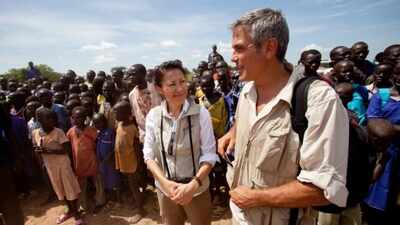
Imagine flipping on Google Maps and catching sight not of cities or roadways, but of the aftermath of a burning village. Now raise the stakes: What if the satellite photos could uncover where violence was breaking out, or serve as proof that the world had not looked away? That’s the vision George Clooney and human rights campaigner John Prendergast chased with the Satellite Sentinel Project (SSP). It didn’t start in 2012, as people often say; the idea took shape in late 2010, after a boots-on-the-ground trip to Sudan, and the project launched just as the region braced for South Sudan’s independence referendum.Per The Enough Project, Clooney and Prendergast realized something simple but game-changing: ground reporting in war zones is dangerous and sometimes blocked off. But satellites? Those just keep orbiting. So, why not use their “eyes” to witness what others might keep hidden?
From Hollywood to humanitarian tech : How George Clooney’s satellite project worked
Clooney’s star power opened doors, but what gave the project teeth was its team-up of heavy-hitter partners: Not On Our Watch, The Enough Project, the Harvard Humanitarian Initiative, the UN satellite team, and players in the commercial satellite world like DigitalGlobe. They weren’t after secret agents or spy-level intel. The goal was to catch the big stuff: think military convoys, burning villages, the sudden appearance of camps for the newly displaced.Analysts compared snapshots over time, sometimes lining up reports from people on the ground with what fresh imagery showed: burn marks, changed patterns of movement, new military outposts. Satellite Sentinel became the world’s first major public effort to monitor human-rights flashpoints with near-real-time space technology.
The ‘Antigenocide Paparazzi’: Watching and warning
Clooney, a Hollywood icon in his own right, famously called the initiative the “antigenocide paparazzi.” His pitch was that if bad actors knew they were being watched, some might at least hesitate. These weren’t just fresh PR photos. The hope was that images, sometimes released to the public within a day, could warn populations or pressure leaders by making atrocities publicly available, fast.In a place like Sudan, that really mattered. Restrictions made it almost impossible for most journalists or agencies to monitor conflict zones. The satellites filled the gap, staring down at stretches of the border region, then at active conflict areas like South Kordofan.
What did the satellites see?
The results? Sometimes, they were chilling. In 2011, the project’s imagery spotted more than 300 new structures near a UN compound in Kadugli, which were shelters for families forced to flee. Images confirmed reports of an entire village razed to the ground. In 2012, they spotted evidence of bombings near a key bridge in Unity State and tracked shifts in military assets.The data proved useful. It backed up what survivors said, became part of Human Rights Watch reports, and even attracted the International Criminal Court’s attention. Between early 2011 and mid-2012, the project’s team released dozens of reports, flagging everything from mass graves to acts that possibly violated international humanitarian law.
How much difference did it make?
Now, here’s the tricky part. Satellite images can provide proof of what was left behind: burned structures, mass graves, military movements. But they can’t always show exactly who is responsible, or why an attack happened. That’s why the project was never just about pixels; it was also about blending what the satellites caught with what people said on the ground.Even so, the presence of “witnesses in the sky” has changed the story. By documenting the aftermath and sometimes warning the world in real time, the Satellite Sentinel Project made it harder for violence and abuses to be swept under the rug, at least not without leaving a trace.
A shift in humanitarian tech
The project’s pilot phase ended in mid-2012. The Harvard Humanitarian Initiative spun off its research in new directions, with the idea of remote detection and public witnessing blossoming into bigger investigations led by The Sentry, now focused on following the money behind conflict and atrocities.George Clooney’s “antigenocide paparazzi” was a humanitarian experiment that proved, whatever its limits, that sometimes, the simple act of looking makes it much harder to hide the truth. A satellite won’t stop a bullet, but the right photograph can force people to see what would otherwise become nothing more than a rumor or a cover-up.In the grim math of modern warfare, a little evidence can go a long way. And a clear image from space? Sometimes that’s the first step toward demanding justice, even if the fight is far from finished.