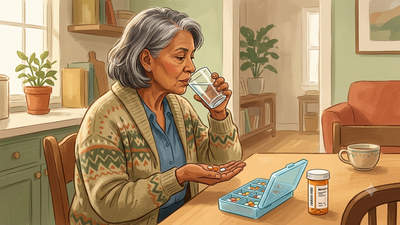
Somewhere in a clinic waiting room, a patient describes a habit that sounds almost too small to matter. One sleeping pill has become two. Two has become three, taken earlier and earlier in the evening, because without them the mind simply won’t switch off anymore. Nothing about this feels like the version of addiction shown in films or warned about on posters. There’s no illegal substance involved, no dealer, no dramatic collapse. Just a prescription bottle that used to sit untouched for weeks and now empties faster than the pharmacy can refill it. That quiet, almost invisible shift is exactly the pattern that worries doctors most, because it can happen with medicines meant to heal, not harm.Prof. Dr. S M Fayaz, Lead and Senior Consultant of Internal Medicine at KIMS Hospitals, Mahadevapura, Bengaluru, has seen this pattern often enough to describe it plainly. Medicines, he says, “are intended to alleviate pain, help sleep, minimize anxiety and assist in the recovery from different health problems.” But the same chemistry that makes them effective is what makes them risky. “Many commonly prescribed drugs can be abused when consumed in high doses, more often, or for longer periods than prescribed,” he explains, and it’s this narrow gap between a therapeutic dose and a harmful one that turns ordinary treatment into a slow-building problem.
Why painkillers can quietly become the goal, not just the treatment
Not every painkiller carries the same risk, and that’s part of what makes this so easy to miss. Opioids, prescribed for genuine acute or chronic pain, do more than dull physical discomfort. According to Dr. Fayaz, they relieve pain “and simultaneously cause relaxation and euphoria,” a combination that changes how the drug feels to take, not just what it treats. “This makes it possible for people to take more drugs than necessary,” he says, and the body doesn’t stay neutral about it either. Over time it adapts, meaning “the patient needs larger doses” just to get the same relief. Some patients cross a line they never intended to cross, moving from managing pain to managing a body that has become “physically dependent,” a state Dr. Fayaz notes “may develop into addiction” if it isn’t caught early.
When a sleeping pill stops being a short-term fix
Sleep medication follows a strikingly similar arc, and it starts from an entirely reasonable place. Doctors prescribe it for insomnia and other sleep disturbances because, used correctly and briefly, it works. The trouble begins when “used improperly,” Dr. Fayaz says, because that’s when “use of these medications can create problems.” What often happens next is psychological as much as physical: people become convinced they simply cannot fall asleep without the pill in their system. “This dependency can be physical or psychological, making it difficult to quit taking the pills,” he says, and stopping abruptly rarely goes smoothly. Patients who try often find themselves facing “insomnia, restlessness, or anxiety,” the very symptoms they were trying to treat in the first place, now returning in a harsher form.His advice cuts against the instinct to simply take more. Instead of increasing the dose, he says the better path is to ask a more basic question: what is actually behind the sleeplessness. Sometimes “these problems can result from a medical condition,” and sometimes they trace back to nothing more complicated than poor sleep habits, an answer far less satisfying than a pill but considerably safer.
Sedatives, anxiety medicine, and a danger that multiplies
Sedatives and anti-anxiety medications occupy a similar space, offering real relief for panic and worry while carrying real risk if mishandled. The danger here isn’t only about dosage. Because these drugs work by producing sedation and slowing brain activity, Dr. Fayaz warns that “misuse can be extremely serious,” particularly when the drugs aren’t taken alone. Taking sedatives “in doses that are too large, sharing them with others or taking them together with alcohol and opiate pain-relieving drugs” is where the real danger multiplies, he explains, since combinations like these “can result in excessive sedation, breathing problems, or an overdose.” A dose that would be manageable on its own becomes something else entirely once mixed with alcohol or another depressant, a fact that gets lost in the assumption that a prescribed medicine is automatically a safe one.
The warning signs are usually quiet
What makes medication misuse particularly hard to catch, in a family member or in oneself, is how ordinary the early signs look. Dr. Fayaz points to a familiar cluster of behaviours: taking more than prescribed, “often running out and looking for early refills, taking someone else’s medication, hiding their use of a drug, or finding they can’t go on without it.” None of these announce themselves as a crisis. They look, at first, like carelessness, or stress, or bad luck with timing. Alongside them, he says, watch for “mood changes, excessive drowsiness, confusion or alterations in behaviour,” changes that are easy to explain away individually but harder to dismiss once they start appearing together.
A problem that doesn’t discriminate, and a rule that doesn’t bend
Dr. Fayaz is careful to frame this as a risk without a typical victim. “Medication can be misused by anyone,” he says, which is precisely why he urges people not to wait for certainty before acting. If misuse is suspected, in oneself or someone else, he recommends seeking help immediately rather than trying to manage it privately. One instruction he repeats without exception: never stop a long-used medication abruptly without medical guidance, since a doctor “will assist you in deciding how to deal with the problem safely,” and abrupt withdrawal can be its own medical event.His closing point is less a warning than a working principle for anyone with a prescription bottle at home. “All medications, even the most benign ones, can be harmful if misused,” he says. The instruction that follows is almost disarmingly simple, given everything it’s meant to prevent: take medications exactly as prescribed, never adjust the dose independently, and raise any question about a prescription with a doctor before making a change alone. It’s not a dramatic rule. But it’s the one standing between a bottle of pills doing exactly what it was designed to do, and quietly becoming something else.