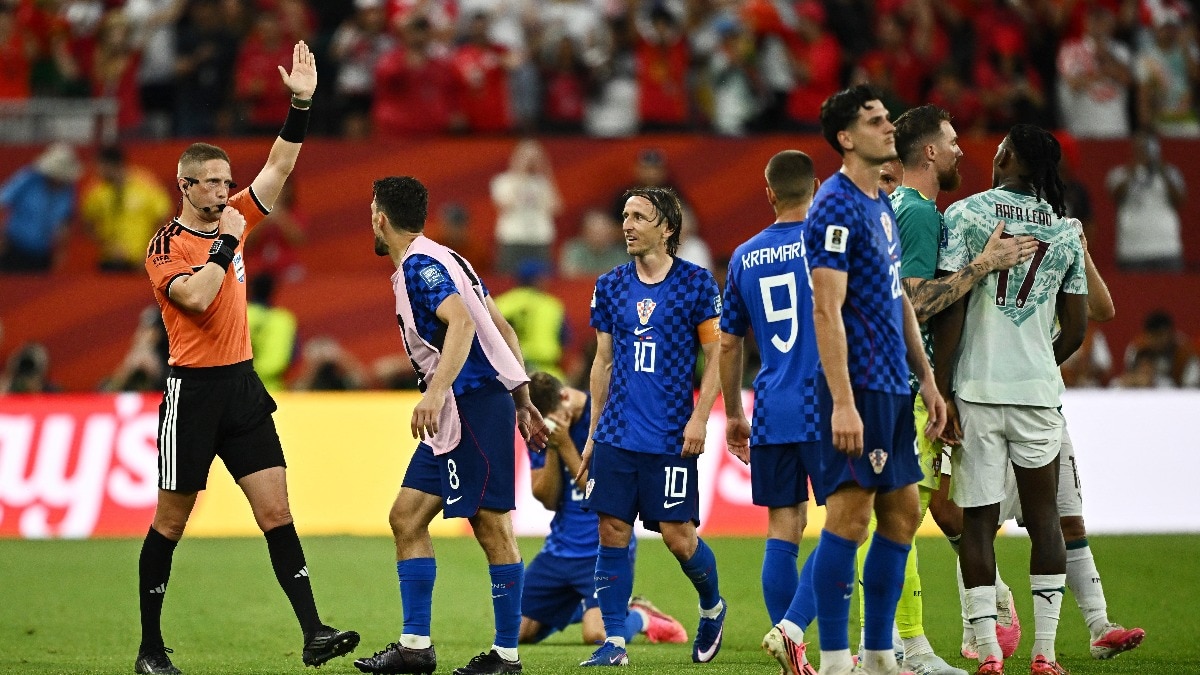
Croatia’s FIFA World Cup campaign ended in heartbreaking fashion after a dramatic stoppage-time equaliser against Portugal was ruled out following a VAR review in their Round of 32 clash on Thursday.
Josko Gvardiol thought he had rescued Croatia in the 103rd minute when he turned the ball home from close range, sparking jubilant celebrations among the players and fans. But moments later, the referee was sent to the pitchside monitor before overturning the goal for offside, allowing Portugal to hold on for a 2-1 victory and book a Round of 16 meeting with Spain.
Earlier, Ivan Perisic had handed Croatia the lead by converting Josip Stanisic’s cross at the back post. Cristiano Ronaldo responded from the penalty spot, calmly sending the goalkeeper the wrong way to score his first-ever goal in a World Cup knockout match across six editions of the tournament.
With the match heading towards extra time, Portugal coach Roberto Martinez made the bold decision to replace Ronaldo with Ruben Neves. The move paid immediate dividends as Rafael Leao delivered an inch-perfect cross for Goncalo Ramos, who powered a header past the goalkeeper to restore Portugal’s lead.
Croatia threw everything forward in search of another equaliser and believed they had found it in the dying seconds. Instead, they were left stunned by one of the most debated VAR interventions of the tournament.
CROATIA’S EQUALISER DISALLOWED
Croatia thought they had forced extra time when Gvardiol bundled the ball into the net after Ivan Perisic whipped a dangerous cross into the penalty area.
Initially, there appeared to be nothing wrong with the move. The assistant referee kept the flag down and Croatia’s players celebrated what they believed was a dramatic equaliser.
However, VAR immediately began reviewing the attacking phase. Officials concluded that striker Igor Matanovic had made a slight touch on Perisic’s cross before it reached Mario Pasalic. While the touch was barely noticeable on the available television angles, it fundamentally changed the offside decision.
Once Matanovic redirected the ball, Pasalic was in an offside position when he received it. Pasalic then squared the ball for Gvardiol, whose finish was ruled out because the attacking move had originated from an offside offence.
The decision sparked furious protests from Croatia’s players, who surrounded the referee after the goal was disallowed. Television replays did little to settle the debate, with many viewers struggling to spot any obvious contact from Matanovic.
BALL CHIP EXPLAINED
The decisive piece of evidence came from the connected Adidas TRIONDA match ball being used throughout the 2026 FIFA World Cup.
Unlike previous World Cups, the official match ball contains an embedded motion sensor that records every contact made with the ball during a match. The sensor captures movement data in real time and allows VAR officials to pinpoint the exact moment a player touches the ball, even when that contact is almost impossible to detect with the naked eye or through standard television replays.
During the review, the sensor confirmed that Matanovic had made a slight touch before the ball traveled to Pasalic.
That detail proved crucial because the offside law judges a player’s position at the precise moment a teammate plays or touches the ball. Since Matanovic had redirected the cross, however slightly, Pasalic’s position at that exact instant became the reference point for the decision.
VAR combined the sensor data with the semi-automated offside technology to establish that Pasalic was beyond the second-last defender when Matanovic touched the ball. Once Pasalic became involved in the next phase of play by passing to Gvardiol, the offside offence was complete, leaving the referee with little option but to overturn the goal.
The technology has often been compared with cricket’s Snickometer because both systems help detect minimal contact that may escape the naked eye. The comparison, however, only goes so far. The Snickometer relies on microphones to detect sound, while the World Cup ball uses an internal motion sensor to measure changes in the ball’s movement after contact.
The introduction of connected-ball technology has helped officials make more accurate offside decisions during the tournament, but it has also brought fresh scrutiny to marginal calls decided by technology rather than what is visible on television.
FIFA World Cup | FIFA World Cup Schedule | FIFA World Cup Points Table | Football News
– Ends