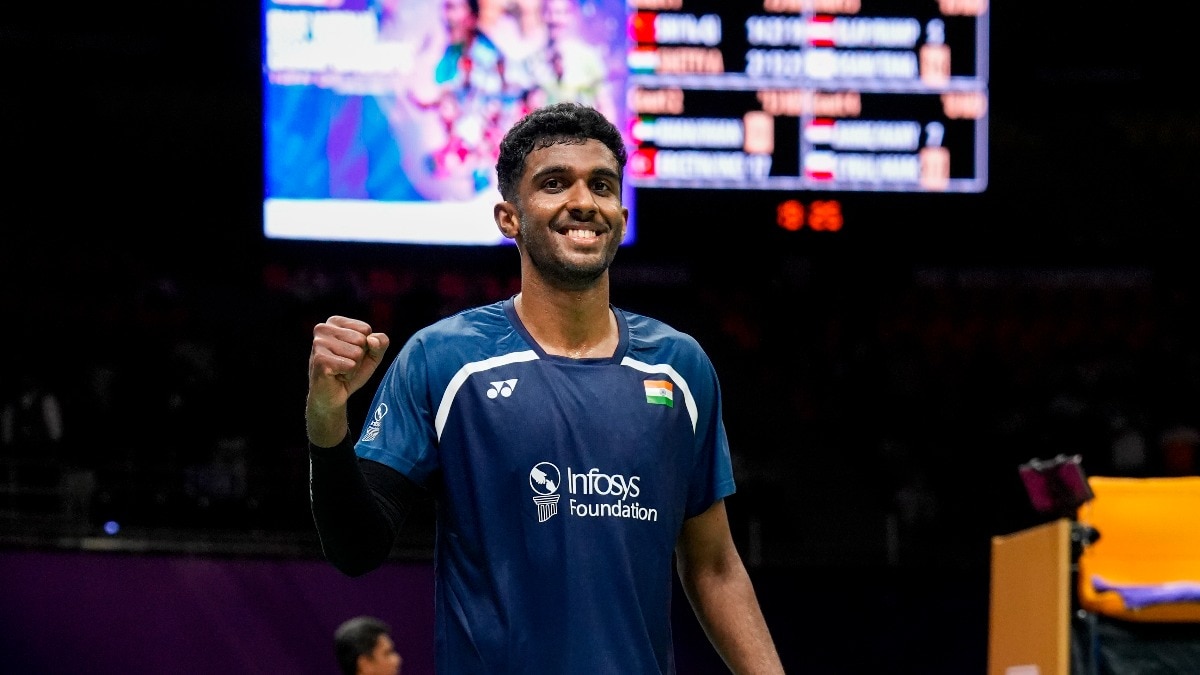
The World Championships draw was unfolding live. Ayush Shetty was watching when the name he had been unable to beat in three attempts appeared next to his.
Shi Yuqi. World No. 1. Defending champion. First-round opponent.
For a 21-year-old making his World Championships debut on home soil, it was the sort of draw that could have made the occasion feel heavier. Instead, Ayush was looking forward to it.
“He never even once… there was a sense of, ‘why am I playing Shi Yuqi in the first round?’ He was looking forward to it,” coach Sagar Chopda said during a Badminton Association of India YouTube live on Monday.
There were other clues to Ayush’s state of mind that morning. He was relaxed during his hit, laughing and joking around. In the car to the stadium, he was still smiling and cracking jokes. And when he walked towards the court, a young fan held out his hand for a high-five. Ayush gave him one.
Small moments, easy to miss, but revealing. Ayush did not look like a player carrying the occasion as a burden. He seemed to be enjoying it.
That did not mean he was unaware of what awaited him. Shi had beaten Ayush three times before, and the last meeting had been particularly brutal. In the Badminton Asia Championships final in April, Shi thoroughly dismantled him in straight games, winning 21-8, 21-10. Ayush had barely been allowed to play on his own terms. Four months later, he was staring at the same opponent again, only this time with a different answer.
“August 17 is a bad day for Shi Yuqi,” coach Vimal Kumar had told Ayush during his preparations in Bengaluru. He wanted Ayush to write it down, something he could look at every day. Vimal told IndiaToday.in that he had been repeating the message to Ayush every day, right from Bengaluru.
On Monday, August 17, Ayush made sure it came true.
He beat Shi 21-14, 13-21, 21-19 to knock the defending champion and World No. 1 out in the first round of the World Championships, finally ending a run of three defeats against him.
Yet when the biggest win of Ayush’s career arrived, there was no wild celebration. There was relief.
Sagar’s first reaction, when asked how he felt, was one word: “Relieved.”
Ayush, speaking to the media in the mixed zone, was feeling something similar.
“I think I’m feeling great. I think it’s a really special win and, yeah, we’re happy with the way I played today.”
POWER, FAMILIAR. PATIENCE, NEWER
He had every reason to feel that way. This was not simply about beating Shi Yuqi. It was about solving him.
The power was familiar. The patience was newer. Ayush Shetty is known for his attack. Standing at 6ft 4in and idolising Viktor Axelsen, he has the frame and the power to make his biggest weapon obvious. When he gets behind the shuttle, his smash can be devastating. Against Shi, those booming attacks were always going to matter.
But the win was not simply about Ayush attacking better. It was about knowing when to attack.
He was patient when the rally demanded it, willing to lift high when he was caught and, crucially, able to turn defence into attack almost seamlessly. A defensive retrieve could become a straight block, the block could change the direction of the rally, and suddenly Ayush would be back on the front foot, waiting for the next opportunity to unleash his attack.
“I knew it would be a really tough match and I really had to work very hard. I think I was mentally prepared, physically as well,” Ayush said.
The preparation showed from the beginning. Playing from the end that allowed him to hit against the drift, Ayush seized momentum early, winning a 45-shot rally before finding his range with the big smashes. But he did not rush to hit them.
“From the back of the court, he was not in a hurry to hit those hard smashes. He’s always been very erratic with that shot,” Sagar said.
Instead, Ayush used his net shots, mixed his clears and lifts and opened up the court. The high lift became an important part of the plan, particularly when he found himself caught out.
“When I was getting caught, I was doing the high return, ready for the defence. I think that managed to work really well and, yeah, I think I was defending quite well as well,” Ayush said.
There was a reason that tactic mattered in Delhi. Vimal, who has watched players compete at the IGI Stadium for years, explained that the shuttle can slightly float in the big hall. When players rush into their jumps, they can struggle to make clean contact.
“So when you jump, sometimes, most of the time you don’t connect properly. Many players are struggling,” Vimal said.
His message to the players had always been to get the timing right. “And once you get the timing right, and if you have a comfortable match, then you can get going,” he said.
Ayush got his timing right. He defended the big shots, made Shi work and, when the opportunity came, attacked. The first game belonged to him, 21-14, and for once, it was the defending champion being made to react.
HANGING IN
The second game was where the story could have taken a familiar turn.
Ayush was no longer playing from the more favourable end and Shi had adjusted. The Chinese star began dictating the rallies, moving Ayush around and making him work for every attacking opportunity. The difference from April was stark, but the memory of that final was still there: Shi had won the opening game 21-8 and then closed out the title 21-10, leaving Ayush with very little room to impose himself.
Here, Ayush had already taken a game off him. But Shi was beginning to find the control he had enjoyed in that final.
At 11-9, the game was still close. Then it became 13-9. Ayush tried to bridge the gap, but playing on the faster side, he was not getting the same control he had enjoyed earlier. He was also trying to play too much at the net, giving Shi opportunities to use one of his strengths.
“Shi Yuqi is quite deceptive at the net,” Vimal said.
“He has that excellent pushes as well to the back of the court.”
Shi began to look quicker, making Ayush run and taking control of the exchanges. The second game slipped away 21-13.
The score was level, and Ayush had just been reminded of how quickly Shi could take control of a match. But rather than abandon the plan, he returned to the better end for the decider and went all out.
THE LEAD THAT ALMOST DISAPPEARED
The beginning of the third game was almost the perfect combination of the two versions of Ayush. He attacked, defended, moved Shi around and lifted when he needed to, but he also waited for his moments. The lead grew to 11-5 and then 16-5.
The biggest win of his career was suddenly four points away.
Except Shi Yuqi was still standing there.
“He is not World No. 1 just like that,” Sagar said.
Shi has a particular ability to make a match look over before it actually is. His body language can drop, he can appear beaten, but just when an opponent thinks he has given up, he can produce five or six points, the coach described.
That was exactly what happened.
Ayush began to get jittery. Shi kept retrieving and the easy finish did not arrive. The 16-5 lead began disappearing, and the match became less about tactics and more about managing what was happening inside Ayush’s head.
“I was telling myself to calm down. I was getting a bit nervous because he was really catching up and the momentum was with him. Everything I did, he somehow managed to retrieve it,” Ayush said. “So I think I was just saying to myself, ‘Calm, calm down,’ and, you know, be aggressive.”
Sagar was feeling it too.
“I think it was, of course, something that we as coaches have to control our emotions,” he said, estimating that his own heart rate was probably at 180.
Ayush was telling himself to calm down. The coach was trying to do the same. And Shi kept coming.
This was where the months of work away from the court mattered. Ayush had started working with a sports psychologist in December, and Sagar said there had been a conscious effort to help him manage his emotions and become more aggressive on court.
“Nothing happens overnight,” Sagar said.
“It is a process.”
At 17-11, as the pressure mounted, Ayush began doing spot jumps after losing a couple of points. It was a small movement, but part of the work he had done to manage those moments. He was trying to get his blood flowing and reset himself physically as the match became increasingly difficult mentally.
The player who had been laughing in the car that morning was now fighting to stop a match that had seemed almost won from slipping away.
He went from 16-5 to 18-15 and eventually found himself at 19-20.
THE MAGICAL PUSH
At 19-20, there was no tactical speech left to give. Ayush had to trust himself.
The deceptive push he played had already appeared earlier in the match. It was not a stroke invented under pressure; it was a shot he possessed. What mattered was the decision to play it at that moment, with the match one point from being lost.
“He has always been good at that shot,” Sagar said.
“It’s something that, as kids, maybe you pick it up. It’s not that, as coaches, you can teach them this.”
What coaches could not teach was the instinct to go for it then.
“That instinct of playing it at that time,” Sagar said.
Shi was ready for Ayush to keep the shuttle at the net. Instead, Ayush pushed it past him, sending it beyond the Chinese star and well inside the back line. Sagar knew immediately that it was in.
“It was way inside, so there was no doubt about taking a challenge or anything,” he said. “And it was a sigh of relief for all of us.”
Relief. It was also the first word Sagar used when asked for his reaction.
Ayush had done it: 21-19. After three defeats to Shi, including the comprehensive loss in the Asian Championships final, he had finally found a way to finish the match when it mattered most.
After the match, Vimal had one more message for him. He had spent days telling Ayush that August 17 would be a bad day for Shi Yuqi. Now he reminded him how close it had come to becoming something else.
“You made it almost a good day for Shi Yuqi,” Vimal told him.
He wasn’t wrong. Ayush had felt the nerves himself, and the home crowd became important as he tried to hold on.
“Definitely. It’s, you know, an energy booster for me, the way they were standing and supporting me at the end, when I was getting really nervous,” Ayush said.
Perhaps that is the biggest difference between Monday and the Asian Championships final. Ayush did not just arrive with a better game plan. He arrived better prepared for the problem Shi presented, both tactically and mentally.
“I think tactically I was much more prepared, and mentally as well,” Ayush said. “I was ready to work really hard.”
And now, there was another round to play.
“I want to keep my head down and focus on the next round for now,” he said. “I think, you know, I’m happy with the win today, I guess, but I think I want to go much further.”
The boy who had watched the draw unfold without flinching had now beaten the man whose name appeared beside his.
On August 17, Shi Yuqi had a bad day. Ayush Shetty had his best one yet.
– Ends