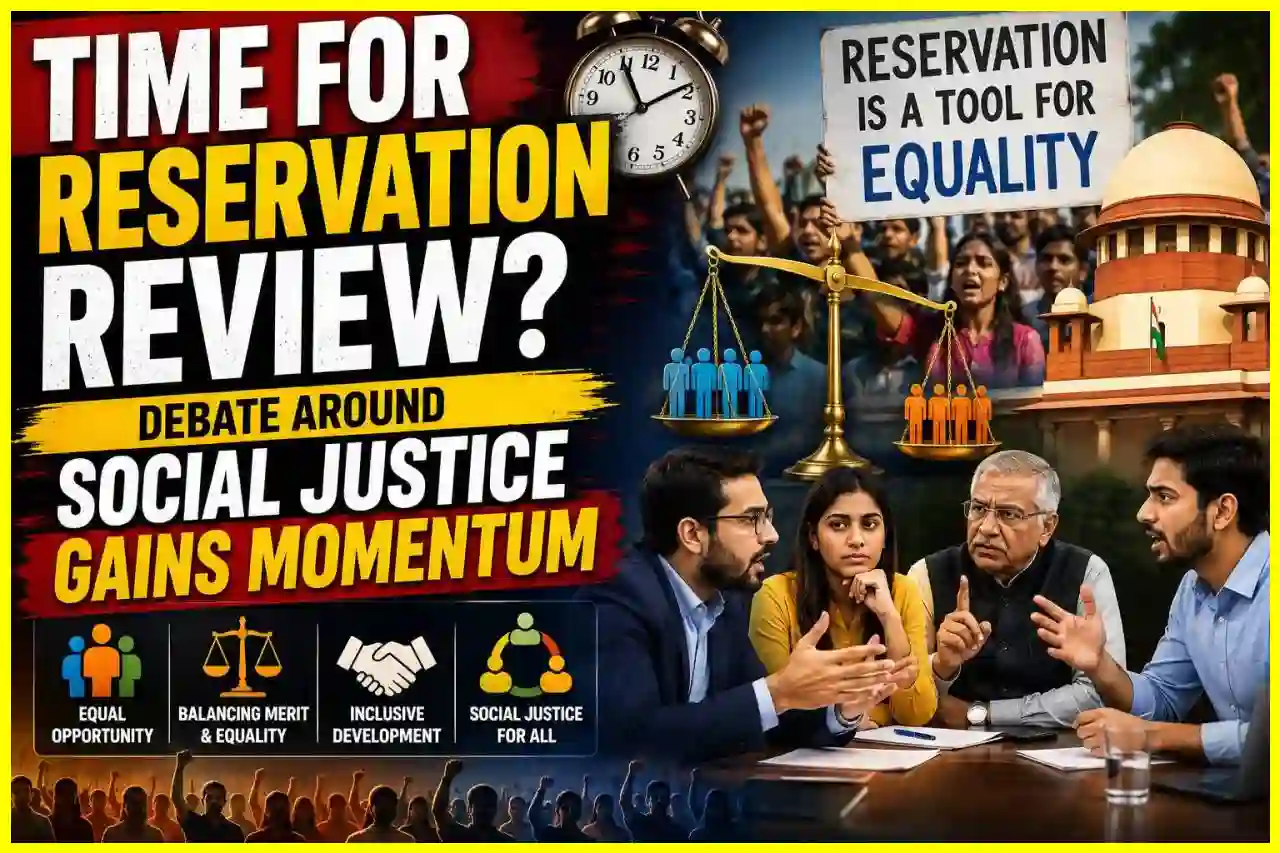
Udaipur, May 24 (Bhagwan Prasad Gaur) – Senior writer Bhagwan Prasad Gaur has called for a serious national discussion on the future of India’s reservation system, raising questions over whether the policy continues to serve its original purpose of social justice or has gradually become a system of long-term privilege for limited sections.
In his article, Gaur stated that reservation was introduced as a constitutional commitment aimed at uplifting socially, educationally and economically disadvantaged communities. However, after several decades, concerns are now emerging over whether the benefits are reaching the truly deserving sections or remaining concentrated among already advanced families within reserved categories.
Referring to recent observations made by the Supreme Court during the hearing of the OBC creamy layer matter, the article highlighted remarks by the bench of Justice B. V. Nagarathna and Justice Ujjal Bhuyan. The bench reportedly questioned whether families that have already achieved significant social and economic advancement through reservation should continue receiving the same benefits for future generations.
The article noted that discussions around reservation in India often become politically charged instead of being based on balanced and fact-driven debate. According to the writer, the issue is not about ending reservation, but about ensuring transparency, effectiveness and fair access to genuinely deserving individuals.
The article further argued that the makers of the Constitution viewed reservation as a corrective social measure rather than a permanent structure. Over time, however, political interests allegedly shifted the focus from social reform to electoral calculations, delaying meaningful review of the system.
Gaur pointed out that many genuinely deprived families still remain outside the effective reach of reservation benefits, while some economically and socially stable families continue to benefit generation after generation. He said this raises important questions about the true spirit of social justice.
The article also questioned why policies such as census exercises, delimitation and economic reforms undergo periodic review, while reservation policies largely remain unchanged despite changing social realities.
Calling for a broader national conversation, the writer suggested that future discussions should examine whether social justice should depend solely on caste identity or also consider education, economic condition and overall access to opportunities.
The article further advocated periodic review of welfare schemes to ensure benefits reach economically weaker sections. It questioned whether financially stable individuals receiving pensions or possessing sufficient resources should continue receiving welfare support originally intended for disadvantaged citizens.
The writer also proposed that ideas such as “one family, one opportunity” could be debated at constitutional and social levels to ensure wider distribution of opportunities among needy families, while maintaining social sensitivity and balance.
Concluding the article, Gaur said India’s democratic strength lies in its ability to engage in honest dialogue on difficult issues. He stressed that social justice should focus not only on protection, but also on fair and transparent distribution of opportunities based on genuine need.
Bhupendra Singh Chundawat is a seasoned technology journalist with over 22 years of experience in the media industry. He specializes in covering the global technology landscape, with a deep focus on manufacturing trends and the geopolitical impact on tech companies. Currently serving as the Editor at Udaipur Kiran, his insights are shaped by decades of hands-on reporting and editorial leadership in the fast-evolving world of technology.